Every young speed skater dreams of skating faster, accelerating harder and competing successfully. Yet the path towards long-term performance is rarely a straight line. The qualities that determine success in inline speed skating do not emerge simultaneously and they do not respond equally to training throughout childhood and adolescence.
A common mistake in youth sport is the assumption that more training and earlier specialization automatically lead to better results. Research and practical experience suggest the opposite. Young athletes are not miniature adults. Their nervous system, metabolism, musculoskeletal system and hormonal profile develop at different rates. As a consequence, the most effective training content changes continuously throughout the developmental process. The challenge for coaches is therefore not simply to train harder, but to train the right abilities at the right time. The concept is reflected in modern long-term athlete development models, which emphasize the alignment of training priorities with biological maturation rather than chronological age.
Inline speed skating represents a particularly demanding example. Success requires technical proficiency, speed, speed endurance, aerobic capacity, anaerobic power, strength, mobility and tactical awareness. However, these abilities should not all be trained with the same emphasis from the first day a child steps onto skates.
Building the Foundation: Coordination and Speed
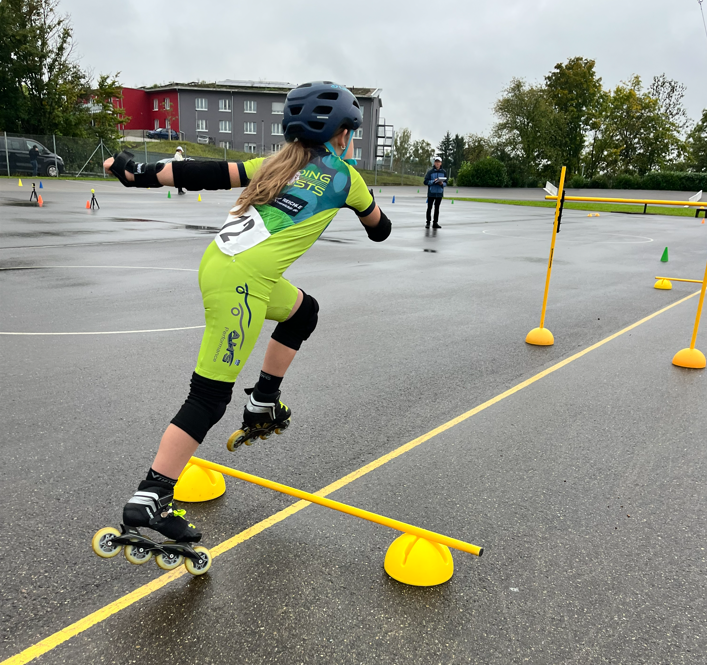
During childhood, training should focus primarily on developing movement quality. Young athletes possess an exceptional capacity to learn new movement patterns and refine coordination. Balance, rhythm, spatial awareness and movement control form the foundation upon which all later performance is built.
This is equally true on skates. Efficient cornering, stable one-leg gliding, effective weight transfer and precise body positioning cannot be developed through fitness training alone. They require thousands of technically sound repetitions performed during a period in which the nervous system is particularly receptive to learning.
At the same time, speed should already be trained from an early age. Contrary to common misconceptions, speed is not solely a product of strength. It is largely determined by neuromuscular qualities that can be improved throughout childhood. Short accelerations, reaction games, agility drills and playful sprint activities allow young athletes to improve speed without compromising enjoyment and long-term development. Research consistently demonstrates positive adaptations of sprint performance in prepubertal athletes when age-appropriate training methods are applied.
Aerobic Endurance: Expanding the Engine
As athletes approach adolescence, aerobic endurance gradually becomes more important. Not because speed skaters compete in marathons, but because aerobic fitness supports virtually every aspect of training and competition.
A well-developed aerobic system improves recovery between intervals, allows higher training volumes and increases the ability to tolerate demanding sessions. Athletes with a stronger aerobic base often recover faster between heats, maintain technical quality for longer periods and adapt more effectively to future training loads.
This does not mean that young athletes should spend hours skating endless laps around a track. In fact, excessive emphasis on monotonous endurance training can limit motivation and reduce time available for technical development. Instead, aerobic capacity should be built through varied and engaging activities that retain a strong technical component.
The objective during this stage is not to maximize endurance performance but to establish the physiological foundation that will support the athlete for many years to come.
Strength Endurance: Holding Technique Under Fatigue
As training volumes increase and competitions become more demanding, athletes are increasingly challenged to maintain efficient movement patterns under fatigue.
This is where strength endurance becomes relevant.
In inline speed skating, fatigue is rarely expressed solely as slower lap times. More often, it manifests itself through technical deterioration. The skating position becomes higher, push-off quality decreases, cornering precision suffers and energy expenditure increases.
For this reason, strength endurance training should not be viewed merely as a muscular quality. It is fundamentally a tool for preserving technical effectiveness throughout a race.
Longer technical intervals, specific skating drills, uphill skating, resistance exercises and well-designed circuit training can all contribute to the development of this quality. The ultimate goal remains unchanged: maintaining technical excellence when the body begins to tire.
Anaerobic Endurance: Learning to Tolerate Race Demands
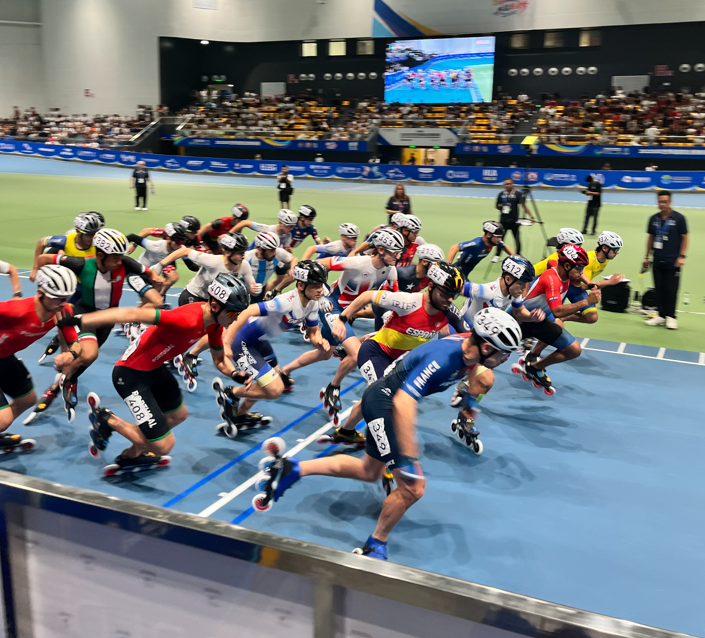
The competitive demands of inline speed skating often involve repeated accelerations, attacks, tactical surges and sprint finishes. These efforts place increasing demands on anaerobic energy systems.
However, the ability to produce and tolerate high concentrations of metabolic by-products develops progressively with maturation. Young children possess a limited anaerobic capacity compared with older adolescents and adults. Consequently, extensive anaerobic training is unlikely to provide the same benefits during childhood as it does later in development.
As athletes progress through puberty, anaerobic endurance becomes increasingly important. Race-specific interval training, repeated sprint work and tactical competition scenarios can now be introduced more systematically to prepare athletes for the physiological realities of high-level competition.
At this stage, training begins to resemble the demands encountered during actual races, where repeated high-intensity efforts frequently determine the outcome.
Maximal Strength: Arriving at the Right Time
Few topics generate more discussion in youth sport than strength training.
For decades, resistance training for young athletes was viewed with caution. Today, scientific evidence clearly demonstrates that properly supervised strength training is safe and effective for children and adolescents. It improves strength, enhances athletic performance and contributes to injury prevention.
The critical question is therefore not whether young athletes should perform strength training, but rather how and when strength training should evolve.
Early childhood should emphasize body control, movement competency and basic force production. As biological maturation progresses, more structured resistance training can be introduced. Eventually, systematic maximal strength development becomes an important tool for improving skating economy, acceleration and power production.
The mistake is not introducing strength training too early. The mistake is allowing maximal strength to dominate the training process before a broad athletic foundation has been established.
The Constants: Speed and Power
While training priorities change throughout development, some qualities remain relevant at every stage.
Speed is one of them.
Power is the other.
From the first skating lesson to elite competition, athletes must learn to apply force quickly and efficiently. What changes is not the importance of these qualities, but the methods used to develop them.
A young child may improve speed through games and playful races. An adolescent athlete may achieve further gains through sprint training, plyometrics and structured strength programs. The underlying objective remains the same: producing fast and effective movement.
For inline speed skating, this is perhaps the most important lesson. Certain abilities rise and fall in training priority as athletes mature. Speed and power remain at the center of performance development throughout the entire journey.